Part 3: Adventures Beyond the Farm
This is just a small slice of our bigger family adventure, but a special one — our stay at Elysium Lake Farm. If you missed the beginning, you can catch up with [Part 1 link] and [Part 2 link].

During our stay at Elysium Lake Farm, we left twice for short two-day adventures. Each time, Al and Jen pointed us toward places worth discovering, drawing on their deep knowledge of the region. From hidden viewpoints to the best stretches of road, they always seemed to know where a good story could be found.
One of their strongest recommendations was to drive to Prince Rupert. We hadn’t managed to catch the ferry from Port Hardy to Prince Rupert at the start of our trip, and they told us to take the detour: “It’s one of the most beautiful roads in the world, and hardly anyone knows about it. Just choose a clear day, you’ll thank us.”
They didn’t just suggest it once and leave it at that — they encouraged us to take the time to do it. Al told us on several occasions that we could extend our stay beyond our original agreement and use the farm as a home base to explore all the wonderful places nearby. With their gentle nudges, it felt less like an optional detour and more like a gift we’d be foolish to pass up.
They were absolutely right.
The drive was breathtaking — towering rock faces, streaks of glaciers, and waterfalls cascading down the cliffs, with the Skeena River weaving beside us. A few clouds lingered, and no photo could really do it justice — it’s one of those sights you have to experience in person.

Our destination was the North Pacific Cannery National Historic Site, just outside of Prince Rupert in the tiny town of Port Edward. It’s an unusual and fascinating place, a living window into how the cannery industry used to operate. The girls loved wandering through the site, imagining the stories behind the buildings — and, of course, their highlight was buying Tootsie Rolls at the old-style general store.

By dinner time, hunger set in and we set out to find a place to eat in Prince Rupert. I decided we’d do it the old-fashioned way — not scrolling through the internet, but walking around town to see what felt right. It wasn’t efficient, but it made the search itself an adventure.
The first spot only served pizza, and Arielle wasn’t in the mood for that.
The second was tucked inside a fancy hotel, which didn’t feel like us.
The third place seemed fine, and we even sat down — but as I looked at Simon, I could tell he wasn’t comfortable. He was ready to “suck it up” because he was starving and didn’t want to keep searching, but something in me resisted. I asked us to get up and keep looking.
That’s when we found Dolly’s Fish Market. What a gift. It had something for everyone, the atmosphere felt welcoming, and the food was absolutely worth the wandering. Sitting there with seafood plates in front of us, we all knew: this was exactly where we were meant to land.

And that’s part of what makes this trip so fun: we leave room for wandering. Not everything is planned, which means beautiful surprises appear — like Dolly’s, like the road itself, like all the little moments we couldn’t have scripted if we’d tried. Looking back, I realize how much of that came from Al and Jen’s generosity. By encouraging us to slow down and savour more, they gave us permission to let the trip stretch out and become richer than we imagined when we first mapped it.

We woke up in Prince Rupert to the fresh coastal air, parked at the Butze Rapids Trailhead. Simon and Arielle laced up for a morning hike through the woods while Élyssa and I stayed back at the bus. It was the kind of quiet, simple start to the day that set the tone for what came next.

By the time we made our way back to the farm, the rain had settled in. It poured most of the day, and we found ourselves so grateful that we’d driven from Terrace to Prince Rupert the day before in sunny weather. That stretch of road — cliffs, waterfalls, glaciers, and the Skeena River beside us — wouldn’t have felt nearly as magical without the sun breaking through.
We made it back just in time for dinner, and in one of those funny, unspoken alignments, Jen and I had landed on the same idea without realizing it. We had picked up a pizza stone as a gift for her, and she had planned sourdough pizzas that very night. It felt like such a perfect little moment of synchronicity — giving and receiving in equal measure, all wrapped around good food and community.
The Nass Valley
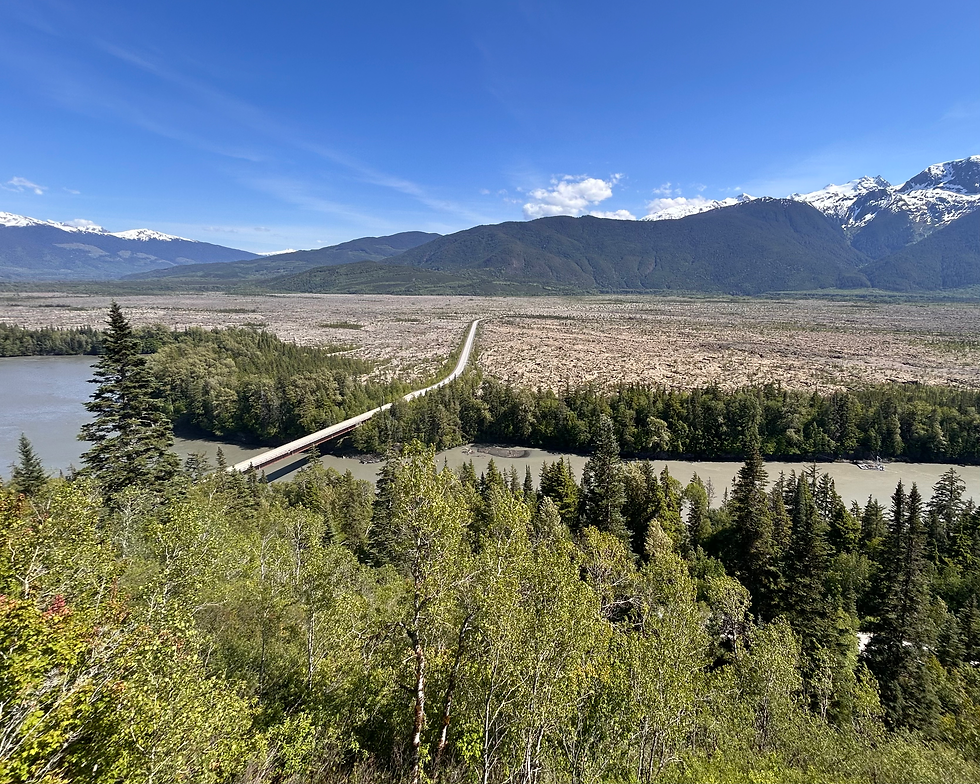
For our second mini-adventure, we set out for the Nass Valley — another stunning drive from Terrace. The road itself felt like part of the experience, winding past waterfalls and towering cliffs. And then, almost suddenly, the landscape shifted into something extraordinary: vast stretches of lava beds, dark and jagged, telling the story of an eruption that reshaped the valley.
Only after passing through this powerful landscape did we reach the quiet villages, each with its own character and rhythm. Every stop along the way offered something new to take in, but the lava beds carried a weight and wonder all their own.
We eventually reached Gingolx, a small coastal community at the end of the valley. We’d been advised to eat at U Seefood You Eat It (just the name alone made us smile), and it turned out to be one of the most memorable meals of our whole trip.

We ordered crab and halibut, and both were incredible. The crab came smothered in the most delicious curry sauce — rich, fragrant, and finger-licking good. Élyssa was so excited about it that Bonnie, the owner, slipped us an extra crab to take on the road. That kind of generosity is something you don’t forget.

We were in a bit of a rush because we had reservations at the Hlgu Isgwit Hot Springs later that evening. Even so, the meal lingered with us — the flavors, the kindness, the surprise of it all.
The hot springs turned out to be the perfect way to end the day. Nestled in the forest, the pools felt both soothing and wild at the same time. The girls especially loved covering themselves with mud from one of the pools, painting their arms and legs before rinsing off in the warm water — and Simon and I couldn’t resist joining in. It was one of those simple, joyful experiences that reminded us how much fun can be found in nature itself.
💡 Travel tip: if you’re planning a visit, make sure to reserve ahead — it’s the only way to access the pools, and absolutely worth it.


That night we camped at the Laxgalts’ap RV Campground — nothing fancy, but perfectly placed for our visit to the museum the next morning.
The next day, we visited the Nisg̱aʼa Museum in Lax̱g̱altsʼap. It was a highlight in its own right. We joined a guided tour led by a local who shared incredible knowledge about the Nisg̱aʼa people, their history, and their culture.

The museum itself is often called “the heart of Nisg̱aʼa House crests” — a name that honors the role of these powerful symbols in Nisg̱aʼa society. Crests are more than decorations; they are emblems of family identity, history, and rights, often represented by animals or supernatural beings, and passed down through generations. Walking through the collection, we learned not only about the significance of these crests, but also about the modern story of the museum itself. It was moving to hear that the Nisg̱aʼa Nation had been able to bring back important artifacts from museums across Canada and beyond, returning them to their rightful place.
I was struck by how Nisg̱aʼa children are born into a role through their family crest. Part of me found that deeply beautiful — to always know where you belong. But another part of me couldn’t help wondering what it might feel like if you didn’t want that role.
Maybe you’ve felt that tug too: the longing, at times, for the certainty of knowing exactly what your role is, and at other times the pull toward freedom — the chance to try on different hats, to explore, to shift. It made me think about how each of us is always balancing those two things: belonging and freedom.
Hearing this alongside the story of the Nisg̱aʼa Treaty — signed in 2000 as the first modern treaty between a First Nation, British Columbia, and the federal government — made the visit even more powerful. The treaty recognized Nisg̱aʼa self-government, returned territory in the Nass Valley, and affirmed their right to protect their culture and resources. Together, the museum and the treaty tell a story that is still unfolding: not just objects behind glass, but a living culture reclaiming its voice, its history, and its future.

We decided to take a short hike to get a better view. It wasn’t the easiest climb, especially with Élyssa voicing her complaints the whole way up, but when we finally reached the top, her expression transformed. She was beaming, proud of herself and wide-eyed at the view. That moment summed up so much of our trip: sometimes the way there is messy, but the reward at the top makes it all worthwhile.
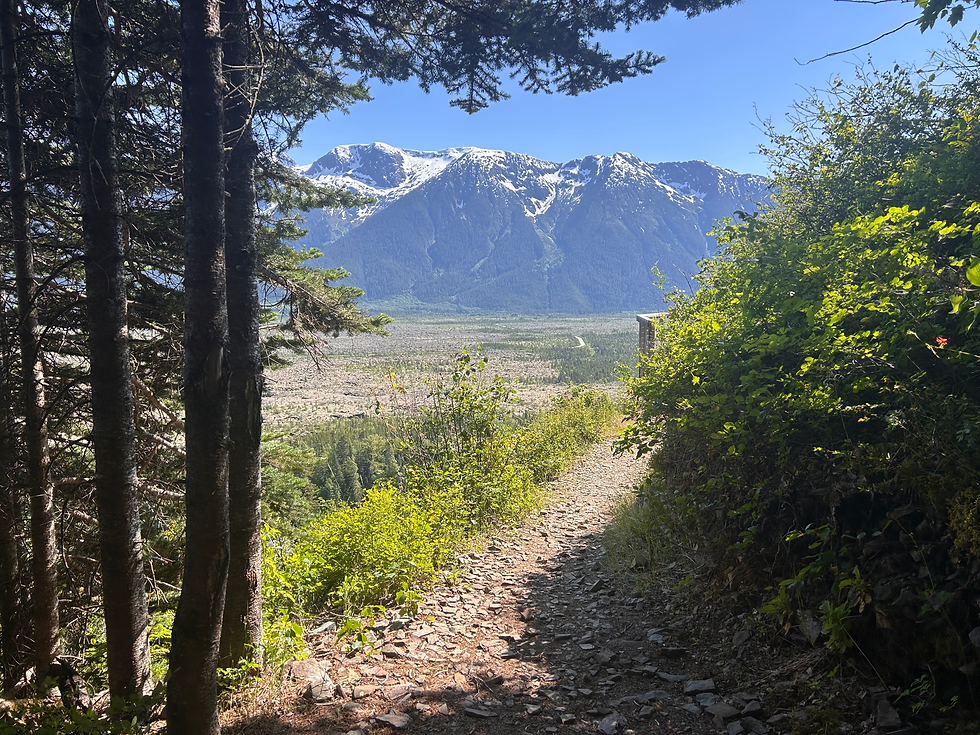
The traditions of the Nisg̱aʼa are deeply inspiring, carrying lessons we could all use today — about resilience in the face of hardship, and about living in closer connection with the land in ways that sustain future generations. One teaching that stayed with us was the guiding question asked when decisions are made: how will this affect seven generations from now?

That perspective struck us deeply. It’s a way of thinking that stretches far beyond convenience or short-term gains — it speaks to responsibility, stewardship, and care that ripple outward long after we’re gone.

For us, this adventure in the Nass Valley became more than just a scenic detour. It was an invitation to slow down, to listen, and to learn from a people whose stories run as deep as the rivers and mountains that surrounded us.
A Gentle Balance

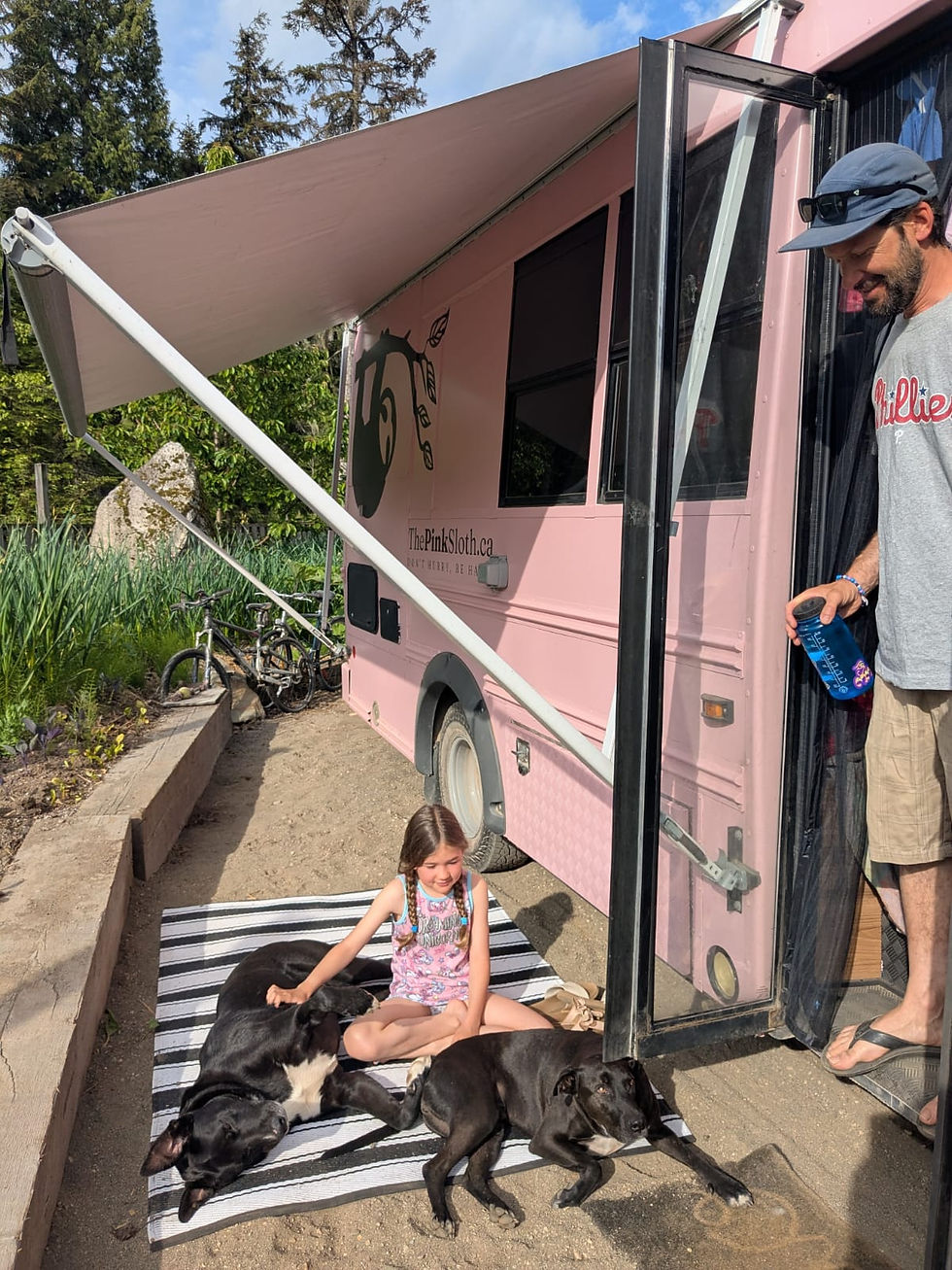
Each time we returned from an outing, the girls were just as excited to get back to the farm — to Jen and Al, and especially to the dogs, Little Poo and Big Poo. That sense of belonging, of being welcomed back as though we were part of the family, made the farm feel like the true centre of our adventure.

Jen had also shared with us that in Nisg̱aʼa tradition, the way First Nations honor the dead is by keeping the first year quiet — no big festivities — while the community steps in to help cook dinners and care for the family left behind. Hearing that gave me a new perspective on how grief and community weave together, and how healing is supported not by busyness, but by presence and shared responsibility.
We had decided to stay at the farm until June 14th to celebrate Arielle’s birthday on the 13th. It was a special moment for our family, and Arielle was especially excited to share her day with Jen, Al, and with Tanyle (Jen’s daughter) and her boyfriend, Graham. At the same time, I couldn’t help feeling a little guilty that we may have imposed on Jen, especially so soon after her own loss. Yet, true to who she is, she welcomed us with grace and generosity, allowing us to both celebrate and reflect. It made me wonder: how do we learn to celebrate the living and honor the dead at the same time, with respect for both? Our time at the farm gave us a glimpse of that delicate balance.

On the morning of Arielle’s birthday, I thought it would be considerate to have breakfast in the bus, since Jen was busy baking sourdough and muffins for the next day’s market. What I hadn’t considered was the patio out back — with the lake and mountains as a backdrop, it turned out to be the perfect spot to begin her day.
That morning reminded me how important it is to let everyone know the plan, even for simple things like breakfast. Clear communication makes space for ease — and more of those beautiful, unexpected moments.

The rest of the day unfolded gently into the rhythm of the farm — harvesting garlic scapes, preparing for market, and finally gathering around the table for one last meal together. It became not only a celebration of Arielle’s birthday, but also a way of honoring our time at Elysium Lake Farm before setting off toward new adventures on the road to Alaska.
Part 4 is less about where we went, and more about what any of us can carry away from a place like Elysium Lake Farm. The lessons are simple, but powerful: generosity, teamwork, communication, and the art of slowing down. At its heart, it’s about setting each other up for success — in daily chores, shared meals, or simply making space for one another’s needs. These are lessons you can bring into your own life, wherever you are.


Comments