Part 1: A Gentle Landing

When we first started planning our trip, we thought we were being clever. Food is always one of the biggest expenses, so why not cut costs by offering a helping hand on farms along the way? In return, we’d learn something new, share meals, and get a real taste of how people live and grow food.
For Simon, it was also a chance to dip his hands into the dream he’s carried for years — the idea of working the land. Volunteering through WWOOF felt like a way to give him a taste of what that life might be like, without the weight of owning a farm ourselves. In our minds, we pictured moving from farm to farm, learning as we went. But the reality was different: not many places accept dogs and kids. So when we found Jen and Al, it felt like we’d stumbled into something rare — a place that welcomed all of us, just as we were.

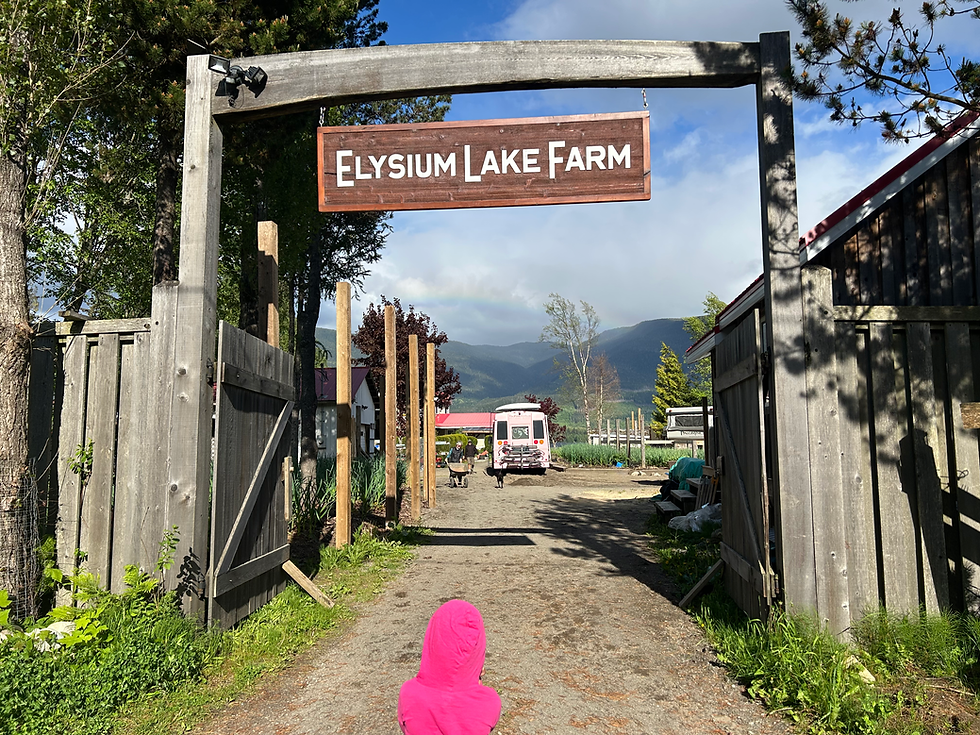
Their little piece of land sat tucked beside Lakelse Lake — just over an acre, yet somehow overflowing with life. They had planted more than 30,000 garlic bulbs, a number that still makes me shake my head when I picture the rows. That fall, the farm had been hit by two floods, and when we arrived, they were in the process of reshaping the land — raising the ground bit by bit and digging new drainage so it would be better protected in the future.

It was a garlic farm and fishing lodge all at once, with a cabin being built out for future guests. Simon jumped in with some carpentry work at first and quickly realized that farming isn’t only about getting your hands in the dirt. There are endless other tasks — building, fixing, hauling, adapting — all the unseen work that makes a farm run. Everywhere we looked, something was shifting, growing, being added. It wasn’t a glossy, postcard farm. It was a property in constant evolution — sandy boots by the door, garlic standing like quiet sentries in the soil, the lake shimmering in the background.

We hadn’t had much rain on our trip, but those first few days here were gray and misty, the kind of weather that softens everything. Beyond the lake rose majestic mountains capped with snow, and every so often we’d catch sight of an avalanche tumbling down their slopes — powerful and fleeting, a reminder of how alive this landscape really was.
And then there were Jen and Al themselves — two incredibly generous and grateful souls. Jen, steady and grounded, carrying both grief and grace in the same breath. Al, a retired mountain guide with a quick wit and an endless supply of wild stories that could light up even the rainiest day. Together they created a kind of welcome that was both calm and alive, patient yet playful. Add in their two dogs — Big Poo and Little Poo — always trotting around like guardians of the farm, and you couldn’t help but feel at home. The girls completely fell in love with them, following them across the yard, giggling at their names, and curling into their fur as if they’d found old friends.

Kuna, our own pup, wasn’t quite as charmed. We tried having her inside at first, but she and Little Poo clashed right away. It didn’t take long to realize that giving Kuna her own space outside was the kinder choice for everyone. Once we found that balance, the dogs each settled into their own roles — and the girls still had plenty of puppy love to go around.
We rolled in on that rainy day, the bus still carrying its mix of road dust and kid energy. Before we’d even unpacked, the girls pulled out a little bag they had carefully prepared along the way — inside were bracelets they’d made just for our hosts. Élyssa had knotted one for Al that read Fly Fisherman, and Arielle had made one for Jen that said Farm Girl. They wanted to offer them right away, a gesture of thanks before we’d even lifted a finger.
That night, when we went to bed, Arielle whispered that she was worried Jen didn’t like hers because she hadn’t put it on right away. My heart clenched, because isn’t that how we all feel when we offer a piece of ourselves? Will it be enough? Sometimes worry is just a glimpse of what we care about most — the hope that what we give will be received with love.
The next morning, Al came to see us, his voice gentle, to tell us that Jen’s stepfather had passed. I braced myself for distance, for Jen to retreat into her grief — but instead, she met us with a calm, grounded presence. She even kept her promise to bake banana bread with the girls. I can still see them at the counter, scooping batter and scattering chocolate chips while the rain tapped softly on the windows. Grief was in the room, yes — but so was grace.

The following day, Jen pulled me aside to say how touched she was by Arielle’s bracelet — and there she was, wearing it proudly on her wrist.

At other moments during our stay, when I was hovering outside, half-wondering how to make myself useful, Jen would look at me and say simply: “Sit down.” And those words hit me harder than I expected. Because when do moms ever hear that? We’re expected to keep moving, fixing, managing — as if pausing means we’re failing. But here was a woman carrying fresh grief, steady in her movements, making space for banana bread and kindness — and reminding me that sometimes, we just need to stop. To sit.
That was my gentle landing.
Jen said more than once that it would be interesting to see what the girls remember about this trip when they’re older. And I think she’s right. They probably won’t remember if I kept the bus tidy or if every meal was perfectly balanced. But they will remember baking banana bread with Jen while the rain fell outside. They’ll remember bead animals at the market, running from the icy lake into a hot tub, and celebrating a birthday with cheesecake on the farm.

And maybe that’s the lesson right there: if our kids carry those small, joy-filled moments with them, then we really don’t need to do it all. We just need to show up. Sometimes, we just need to sit down.
We came for ten days, but stayed for twenty. That in itself says everything.
In the next part of this series, I’ll bring you into the flow of our days at Elysium Lake Farm — the work, the laughter, and the lessons tucked into the ordinary.


Comments